Posts

Quick guide to attending Sitecore Symposium
Image
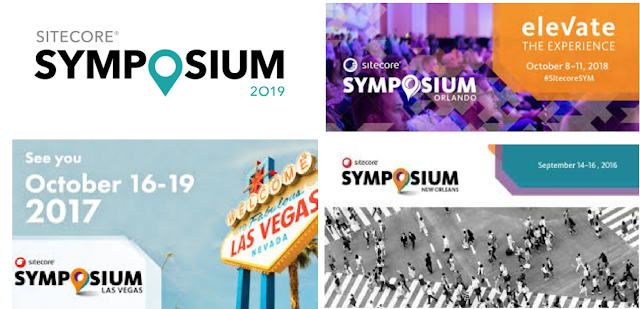
Sitecore symposium is their biggest annual event hosted by Sitecore. It's usually during the month of October or November and officially lasts 5 days Day 1 is considered pre-conference day Day 2, 3, 4 are actual conference days with the Symposium Party on Day 3 and the closing note on day 4 at noon. Day 5 is MVP summit and open to Sitecore MVPs only The attendance is almost a 50-50 distribution of clients and partners. Buying a pass If you are selected as a speaker you get a free pass. Early bird pricing can save you hundreds so look out for early bird pricing dates. If early bird pricing has expired. If you are a partner, you could become a sponsor and score some free passes. If you are a client or prospect, you should get in touch with your vendor partner as they may have discounted passes or even free passes they can offer you. If you are an individual looking for a last min discount, follow #SitecoreSym on Twitter for $100 discount code from Sitecore MV...

Sitecore PaaS deployment topologies for Multi-regional scaling

As we all know, there are two main deployment topologies for Sitecore XP: Single - mostly for developer and integration environments Scaled - for all other environments This post is intended to cover regional deployment and scaling options for a fully scaled production PaaS deployment. There are three ways in which you can regionally scale Sitecore: Regionally scaled content delivery with shared xDB Regionally scaled content delivery with isolated xDB Regionally isolated Sitecore deployment Option #1 is the most common scaling option and works in the the following scenario: Content & experience management is regionally centralized Marketing operations, marketing automation and digital marketing activities in general are regionally centralized Web analytics collection is regionally centralized This basically means that operationally speaking, the organization is fairly centralized in their management and governance for the following: Content cre...

Sitecore, GDPR, China's Cyber Security Law (CSL) & Data Protection Regulation (CDPR)

China has had strong data protection regulation for a while and it only seems to be getting tighter in 2019.  Increasingly, clients running Sitecore as their digital CXM platform require multi-regional deployments, and deploying solutions in the APAC region usually tends to pose a challenge. A couple of years ago, it may have been easy enough to simply carve out some infrastructure local to China and direct all local language variant traffic to the instance. But this is no longer sufficient. China seems to have taken a lot of articles from GDPR and continues to add to them and make privacy law even from stringent. Sitecore has quite a few provisions OOTB for handling some of the GDPR articles and the other can be handled via either solution design, custom implementation or system architecture. Here is are some of the ToDos related to CSL, CDPR as they relate to GDPR. Compliance via solution design & custom implementation CSL & GDPR: Implement consent...

Sitecore Symposium 2018: Session Recommendation Engine

Image
Here is the slide deck from my presentation at Sitecore Symposium 2018. Update: Uploaded deck to SlideShare. Sitecore: Session recommendation engine from VarunNehra

Accelerating Time To Market with Sitecore & Helix

Image
Here is my slide deck for my talk at  Sitecore Digital Destiny Tour 2018 . Update: Link to SlideShare Accelerating Time To Market with Sitecore & Helix from VarunNehra

Azure Kubernetes Services vs Azure Service Fabric, which one to choose for microservices architecture?

Image
On a recent project, we proposed microservices architecture for e-commerce to the a client and it was a no brainer.  The next decision was to choose a hosting provider. The client had subscriptions for both AWS and Azure and since the team predominantly had Microsoft skills, that decision was easy enough as well.  In Microsoft Azure, we primarily were looking at two options: Azure Kubernetes Service (AKS) Azure Service Fabric (ASF) The System Engineers were pretty set on their recommendation of AKS but the client wanted to go through a detailed analysis of  the pros and cons before arriving at a decision. So the team put together a good comparison chart between the AKS and ASF and arriving at the conclusion that AKS is the future of for hosting microservices.  During all the analysis and research, our CTO came across a very elegant decision tree that made it much easier for the client to digest and arrive at their own conclusion. I thought it was ...

Sitecore Testing Matrix

Image
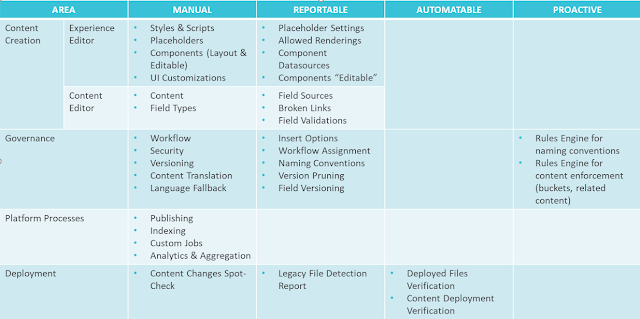
A while back I worked on a Sitecore specific QA assessment for a client. The idea was to take our QA competency's methodology and best practices and tailor them to be Sitecore specific. One very interesting out put from it was what I called Sitecore Testing Matrix. Here it is:

Which e-commerce architecture is best for you?

There was a great report from Gartner a while back that summarized e-commerce architectures into three categories: Commerce-led architecture Experience-led architecture API-led architecture Following which, Rob Earlam wrote a great summary of Sitecore Experience Commerce's experience-led architectur e. Looking back at my e-commerce experience, I would like to propose a possible fourth one, which is Hybrid Architecture.   Now, before I get into the Hybrid architecture. Let me quickly summarize these three architecture types. Commerce-led Architecture The idea here is simple, self-contained commerce solution, often times a monolith, where each every commerce feature is tightly coupled. The advantage in this case is in quickly deriving ROI from the system by shortening the time to market. However, there are several disadvantages to this approach such as single point of failure, lack of scalability options, high cost of maintenance etc. Experience-led Archit...

Back to Basics: Fetch Solr Index Field Name for Sitecore Fields Using Solr FieldNameTranslator

Image
I have been meaning to write this post for a while as I have been using this nifty little feature in all my content search API implementations using the Solr provider. Unsafe: Defining SearchResultItem classes using hard coded Solr fields names for IndexField data annotation attributes as follows: [IndexField("page_title")] public string PageTitle { get; set; }   Problems : Cause runtime errors when field names change in Sitecore Hard coded strings, sort of magic values Unmanageable code Safe: Define SearchResultItem classes using strongly typed constants for data annotation attributes as follows: [IndexField(SampleItem.PageTitleSolrIndexFieldName)] public string PageTitle { get; set; } Solution : Compile time errors are way better than runtime errors More manageable code More readable code More dynamic query building Trick : Fetch Solr translated field name values on template fields  using  FieldNameTranslator  and reference them  w...

Experience Marketing: The Crawl, Walk, Run of Sitecore - Part 3 - The Run Phase

Image
Achieving the  Run phase means that you have arrived when it comes to your digital marketing goals and capabilities. Before you continue with the Run phase, if you haven't already read Part 1 and Part 2 of this 3 part series, I highly recommend reading the Crawl and Walk phases first. As this the last phase of experience marketing maturity, sky is the limit to what you can do with Sitecore's experience marketing features. Let's see what more we can do within our four categories of experience marketing tasks: Content Profiling Content Personalization Contact Profiling Analytics The Run Phase One thing you will start to notice as we get into the Run phase is that you start to blur the lines between the 4 categories mentioned above. Each category will start to get intertwined with another. Let's see how occurs in this phase: Content Profiling - Run Phase By now you should have a good grasp of audience segmentation and having arrived at well define...